

What if the most reassuring cybersecurity advertisement is not the one promising complete protection, but the one confident enough to show how protection actually works?
Cybersecurity advertising has traditionally relied on danger: red warning screens, anonymous figures in dark rooms and urgent claims about the next attack. These images make the threat immediately recognisable, but they rarely help a buyer understand why one security company deserves greater confidence than another.
The industry has a stronger story available. Security teams prevent disruption, protect essential services and help organisations recover when something goes wrong. Good advertising can make that value understandable without turning every campaign into another warning.
Fear can attract attention without earning confidence
The risks are real. The World Economic Forum’s Global Cybersecurity Outlook 2026 found that 94% of respondents expected AI to be the most significant force changing cybersecurity during the year ahead, while 87% identified AI-related vulnerabilities as the fastest-growing cyber risk during 2025.[1]
Microsoft’s 2026 Digital Defense Report also found that phishing accounted for 23% of the intrusions it observed, rising from 7% the previous year.[2] The same report noted that attackers can begin exploiting some newly discovered vulnerabilities in less than 24 hours.
These findings give cybersecurity advertisers plenty to discuss. The problem begins when the campaign stops at the threat.
A buyer who already understands the danger does not need another advertisement telling them to be afraid. They need to know what the company sees, how it responds and what evidence supports its claims.
Fear explains why security matters. Proof explains why a particular security brand should be trusted.

The familiar imagery has lost some of its meaning
Padlocks, shields, glowing code, and hooded hackers have become visual shorthand for cybersecurity. They communicate the category quickly, but repeated too often, they make different companies appear interchangeable.
This creates a creative problem. The more security brands rely on the same symbols, the harder it becomes for buyers to remember who said what. A campaign may look suitably technical while revealing almost nothing about the product, the people behind it or the experience of working with the company.
A more useful creative direction begins with a specific situation.
Consider an AI-assisted phishing attack that imitates the language of a senior executive and arrives during a busy financial approval period. Advertising could dramatise the pressure without exaggerating it, then show how the security service detects the unusual request, gives the employee enough context to question it, and helps the organisation respond.
The threat still creates tension. The difference is that the brand now has a meaningful role in the story.
Trust becomes stronger when the evidence is visible
Cybersecurity buyers are being asked to place considerable confidence in products they may never fully observe. They are purchasing monitoring, protection and response capabilities in the hope that many of the worst outcomes never occur.
Advertising therefore needs to do more than create awareness. It should give the audience a practical route from the claim to its evidence.
That might include a documented response time, an independently verified certification, a customer account of an incident, a product demonstration or a report explaining how the company studies emerging threats. Each piece helps the buyer examine the promise rather than simply receive it.
The World Economic Forum found that 64% of organisations had introduced processes for assessing the security of AI tools in 2026, compared with 37% the year before.[1] The increase suggests that buyers are becoming more deliberate about verification. Security advertising should reflect that change.
A bold headline can earn attention. The material behind it must reward scrutiny.
AI can accelerate the campaign, but not define its point of view
AI can help creative teams examine research, explore campaign routes, produce variations and adapt material for different audiences. Used carefully, it can reduce repetitive production and leave more time for judgment.
It can also make average advertising easier to produce at scale.
If every company begins with the same threat report, enters a similar prompt and selects from similar visual conventions, the result may be efficient but difficult to distinguish. More content enters the market while the brand becomes less recognisable.
The creative advantage will not come from generating the largest number of assets. It will come from deciding what the company can say with authority.
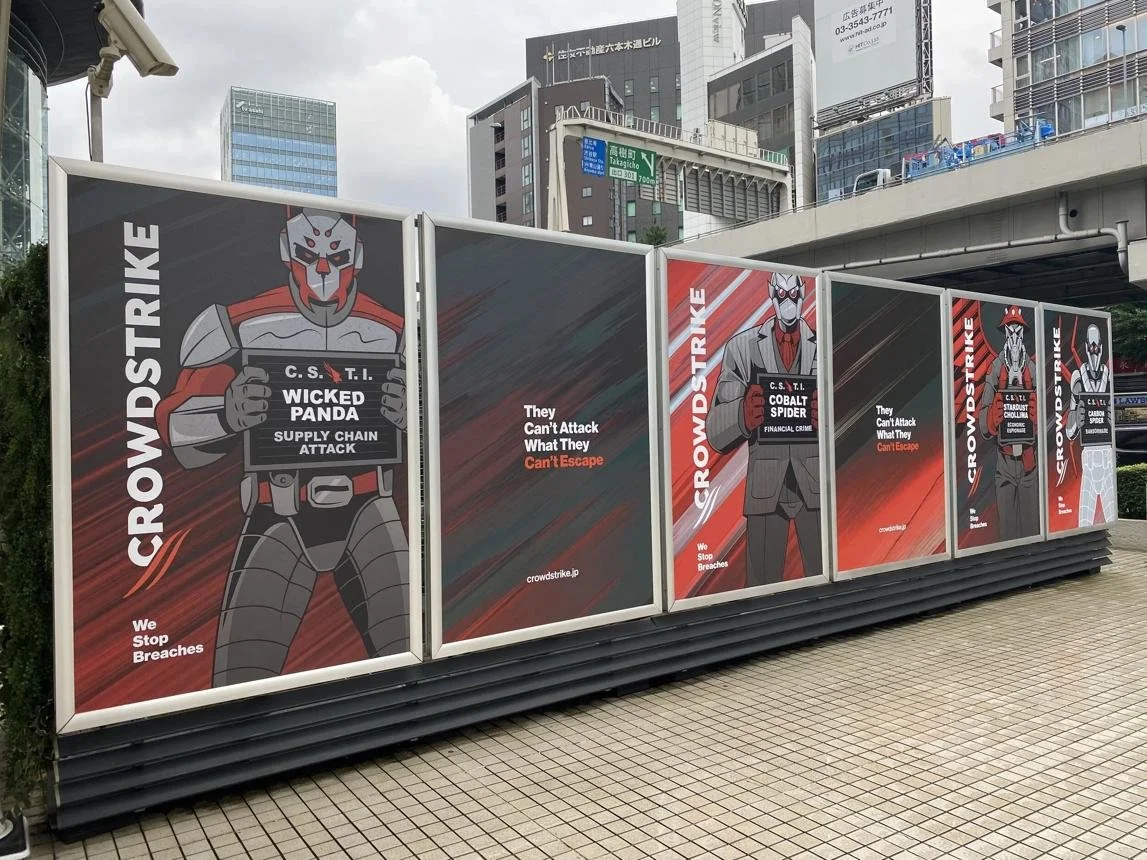
CrowdStrike offered one example through its “This or That” brand campaign. Instead of presenting cyber risk as an anonymous figure behind a laptop, the campaign placed its AI-powered character, Charlotte, against four distinct adversaries targeting financial services, healthcare and smaller businesses. The creative treatment simplified a complicated subject, but its premise remained connected to CrowdStrike’s work in threat intelligence, adversary behaviour and incident response.[3]
The campaign demonstrates what happens when technical knowledge becomes part of the creative idea. CrowdStrike did not need to invent an unrelated story around its product; it translated what its security teams already understood into characters, conflict and a format that a wider audience could follow.
Security companies often hold similarly valuable material that advertising never reaches: patterns discovered during investigations, lessons from difficult incidents, observations from customer conversations and practical explanations from analysts. Turning that knowledge into accessible stories can give a campaign substance that generated imagery alone cannot provide.
A security brand can communicate confidence without pretending risk has disappeared
Positive cybersecurity advertising does not require false reassurance. No credible company can promise that every incident will be prevented.
Confidence can instead come from preparedness: showing how quickly the company identifies a problem, how clearly it communicates during an incident and how its people help the customer make the next decision.
This changes the emotional centre of the campaign. The attacker is no longer the most memorable character. The customer’s ability to respond becomes the story.
The visual identity can support that position through calm typography, direct language, intelligible diagrams and imagery connected to real working environments. Rather than making the technology look mysterious, the creative work helps the audience understand it.
A strong security brand should make a complicated decision feel more manageable.
The better story is already inside the business
Cybersecurity companies do not need to make threats appear more dramatic. Buyers already understand that the environment is uncertain. The greater opportunity is to show how the organisation behaves within that uncertainty.
What does the team notice that others might miss? How does the product help someone act sooner? What happens after an alert appears? Which claims can be demonstrated, independently checked or explained through customer experience?
These questions can produce advertising that remains creative without losing credibility.
Security brands sell expertise, preparedness and dependable action. Their advertising should make those qualities visible—not through louder warnings, but through specific stories and evidence people can examine.
The industry has spent years explaining what could go wrong.
Its better story is what capable people can do next.
Working on a cybersecurity campaign? Humind Creatives helps B2B technology teams turn complex security subjects into focused ideas and credible creative work. If your next campaign needs a stronger story, let’s talk.
References
World Economic Forum, Global Cybersecurity Outlook 2026: Executive Summary, 12 January 2026.
Microsoft, Microsoft Digital Defense Report 2026: Governments Now Most Impacted Sector, 8 October 2026.
